
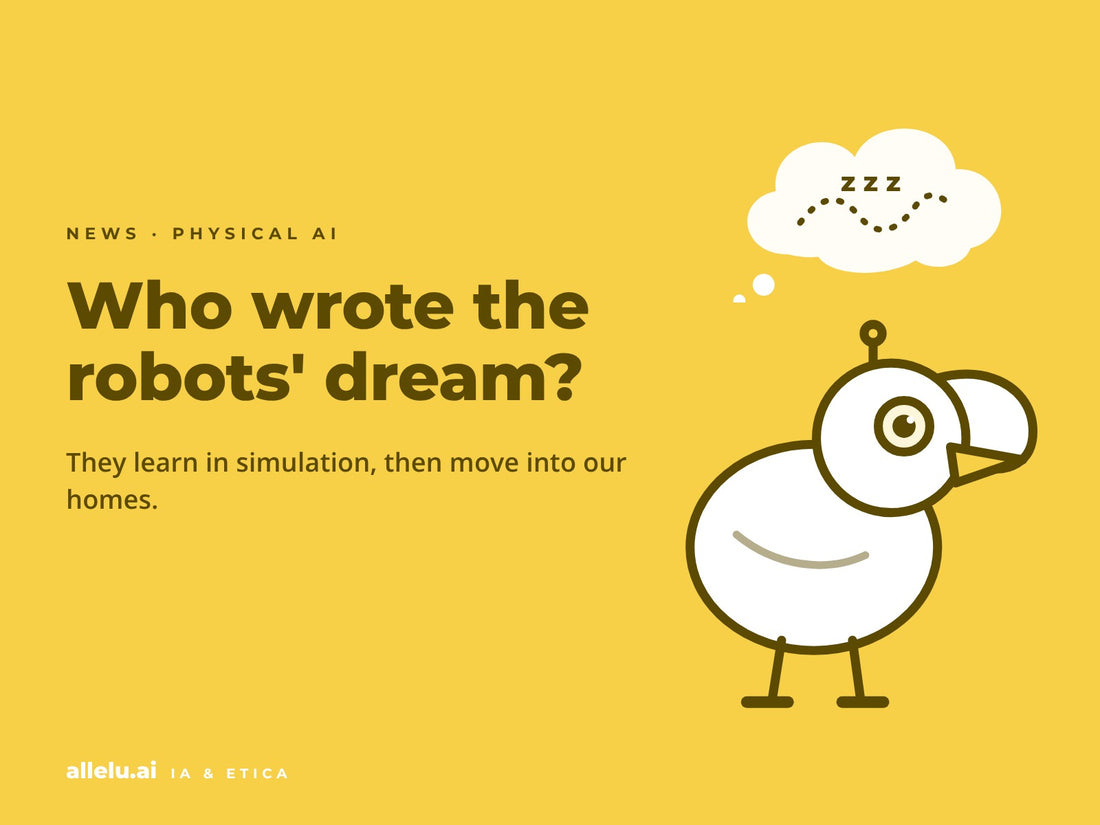
Why Nvidia's boss talks to his robots like puppies
Article written on 22 October 2026. This story is moving fast: some details may have changed since.
Imagine a puppy that learnt its tricks while dreaming.
Every night, in its dream, it practises thousands of times: sit, lie down, roll over. When it wakes up, it already knows how.
One day, that puppy arrives in your living room. It is tiny and adorable. You talk to it like a pet.
But this puppy has a camera instead of eyes. And you did not write its dream. It can entertain you and teach you things. It can also see and hear more than you think.
For now, it is not very good yet. On stage, it often falls over, like a toddler learning to walk.
That is exactly what happened on 21 October in Berlin. Jensen Huang, the boss of Nvidia, showed off four little duck-shaped robots. They learnt to move in a virtual world before doing it for real. Behind these ducks lies a real question of artificial intelligence and ethics: what are we going to let into our homes?
This is not science fiction. These robots are already on sale, and the first ones are due to ship before Christmas.
The good news: their code is public. Anyone can check what they do and teach them new tricks. As long as someone actually looks.
So, before you welcome a robot that learns by dreaming, ask yourself one simple question: who wrote its dream?
For those who want the details, here is what happened.
The video: four ducks on stage
Video posted on LinkedIn by the Evolving AI page. The full keynote is available on Nvidia's YouTube channel.
What happened, simply put
On 21 October 2026, Jensen Huang gave a keynote at the Tempodrom in Berlin, the last stop of a European tour that took in London, Paris, Stockholm and Dublin. Nvidia's chips power a large share of today's artificial intelligence systems.
On stage, he was joined by four small robots, each about 25 centimetres tall: the Microducks. They are designed by Pollen Robotics, a young French company bought in 2025 by Hugging Face, a platform where researchers and developers share open AI models.
Jensen Huang asked them to take a nap, then to do somersaults. Not everything went to plan: according to Reuters, three of them fell over and one ended up facing the wrong way. The Nvidia boss told it off: "Pay attention, stay focused."
How do these robots learn? Through "reinforcement learning". It works like a game: the AI tries a movement, gets it wrong, earns a point when it succeeds, and starts again thousands of times. This training happens in a simulation, a virtual world that reproduces gravity and bumps. What it has learnt is then transferred to the real robot.
The Microduck costs about 399 dollars. It has a camera, a sensor that measures distances (a lidar), and it can get back up on its own after a fall. Its software is "open source": the code is published, and anyone can read it, check it and change it.

Beyond the ducks, Nvidia's message is clear. For Jensen Huang, robotics will be the next great industry. People call it "physical AI": artificial intelligence that no longer just writes or talks, but acts in the real world, with a body. According to Reuters, Nvidia says it has committed nearly 10 billion dollars to Europe's tech ecosystem, and the German company Agile Robots plans to build 1,000 to 2,000 small humanoid robots with Nvidia next year.
Artificial intelligence and ethics: why a cute robot raises serious questions
On LinkedIn, many people smiled at the sight of Jensen Huang talking to his robots like pets. It is endearing. It is also the point worth thinking about: cuteness lowers our guard. Cinema showed this long before us, with films such as Her.
Three questions to ask:
- What does it see? A home robot has eyes and ears. According to TechCrunch, apps installed on the Microduck can access its camera and microphone and send that data to outside services.
- Who wrote its dream? What the robot learns in simulation depends on the rules set by the people who built that virtual world. Those choices are never neutral.
- What happens when it gets it wrong? A 25-centimetre duck falling over is funny. A humanoid robot in a factory or a home is another matter. Responsibility remains human, as we saw with AI that breaks out of its cage.

There is a collective question too. According to The Register, an analyst at Forrester points out that relying on Nvidia, an American company, is not enough to give Europe technological sovereignty. Who builds the brains of the robots that will enter our homes and factories?
The hope: learning with robots, not leaving them to learn alone
Yet this little duck has a rare quality: it is open. Its code is public, and so is its simulator. A school, a club or a curious parent can look at how it learns and teach it something else. It is the opposite of a black box.
Building the city rather than the tower of Babel means exactly this: technologies we can understand, check and correct, in the service of people. Not machines that charm us while others decide for us.
My advice: before you welcome a robot or a connected device that learns, take three steps. Look at what it captures: camera, microphone, connection, and switch off what you don't need. Check where its data goes: which apps are installed, and who designed them. Stay the adult in the room: never leave a child alone with it, and remind them it is a machine, not a friend.

What about you?
Would you welcome a robot that learns by dreaming into your home, or your office? And who would you trust to write its dream?
If you found this article useful, sign up to the allelu.ai newsletter: every Thursday evening, one piece of AI news explained simply, through the lens of ethics. And forward this article to someone who should read it.
This fascination with what is powerful, abundant and endearing all at once lies at the heart of my book L'abondance tuera (in French).
Reynald Naulleau is the author of L'abondance tuera and the founder of Allelu AI (allelu.ai), a place to understand artificial intelligence and ethics, without jargon.
Sources
- Reuters (via KSL), "Nvidia's Huang hails Europe's AI potential, flanked by robot ducks", 21 October 2026: read the article
- The Register, "Jensen Huang sends in the robot ducks to sell Nvidia's AI-everywhere vision", 21 October 2026: read the article
- TechCrunch, "Hugging Face is selling a cute $399 open source duck robot, Microduck", 27 August 2026: read the article
- TechEBlog, on the Microduck demo in Berlin: read the article
- Nvidia, "NVIDIA GTC Berlin 2026 Keynote With CEO Jensen Huang" (video): watch the video
- Evolving AI, LinkedIn post with the video of the demo: see the post
Written with the help of AI, reviewed and approved by Reynald Naulleau.