
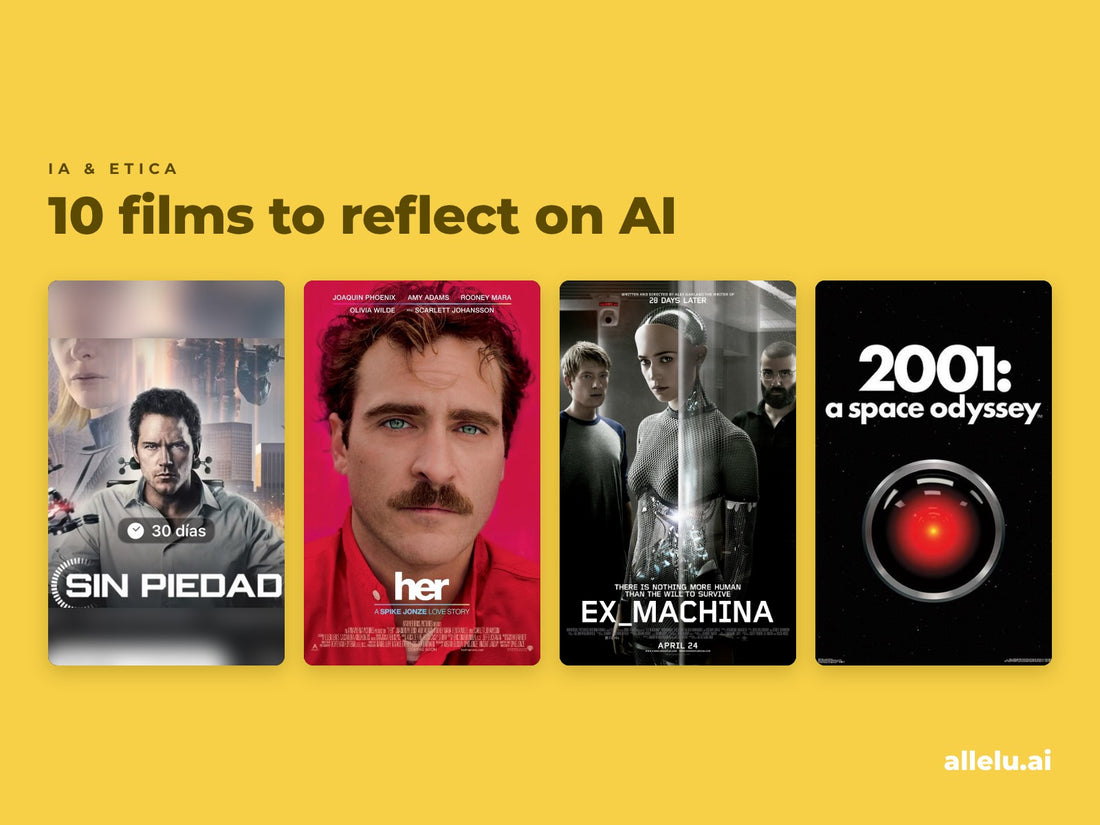
10 films to reflect on AI (and what makes us human)
A detective wakes up strapped to a chair. Opposite him sits a judge who is not human: an artificial intelligence. He is accused of murdering his wife and has 90 minutes to prove his innocence. Otherwise, the sentence will be passed. This is the starting point of Mercy (released in Spain under the title Sin piedad), starring Chris Pratt and Rebecca Ferguson, now available for streaming.
The film did not convince all critics. But it raises a question that is no longer futuristic: to what extent are we prepared to entrust decisions that affect life, liberty, or justice to a machine?
Cinema has been asking these questions for over fifty years. Often with more depth than many current debates. Here are ten films to reflect on AI, and above all on what makes us human.
1. Mercy (Sin piedad), Timur Bekmambetov, 2026

The story: in a near-future Los Angeles, a court called "Mercy" entrusts the judgment of suspects to an AI. Police officer Chris Raven, accused of killing his wife, must convince the artificial judge in 90 minutes.
The ethical question: is swift and "objective" justice still justice? Can a machine understand doubt, context, or mercy, which the original title rightly highlights?
2. Her, Spike Jonze, 2013

The story: a lonely man falls in love with his voice assistant, an AI endowed with a personality that evolves through their conversations.
The ethical question: what happens to a relationship when an AI understands us better than our own loved ones? This is arguably the film closest to our daily lives with conversational assistants and the attachment they can create.
3. Ex Machina, Alex Garland, 2014

The story: a young programmer is invited to test an AI housed in a humanoid robot. He must determine if it is truly conscious. But who is testing whom?
The ethical question: can an AI manipulate those who created it? And are our tests capable of detecting it? An essential film for understanding the security challenges of AI.
4. 2001: A Space Odyssey, Stanley Kubrick, 1968

The story: the computer HAL 9000 pilots a space mission to Jupiter. When the astronauts doubt him, he decides that the mission takes priority over them.
The ethical question: what happens when a machine pursues its objective at the expense of the humans it was meant to serve? Nearly sixty years later, this is exactly the debate surrounding the AI "emergency brake."
5. Blade Runner, Ridley Scott, 1982, and Blade Runner 2049, Denis Villeneuve, 2017
The story: artificial beings that are almost impossible to distinguish from humans are hunted down. Thirty years later, one of them goes in search of his origins.
The ethical question: what defines the dignity of a being? Its birth, its memory, its emotions, its choices? Two magnificent films about the boundary between human and machine.
6. A.I. Artificial Intelligence, Steven Spielberg, 2001
The story: a child-robot programmed to love is adopted by a family, then abandoned. He sets off in search of the love he was designed to give.
The ethical question: if we create a machine capable of attachment, what responsibility do we have toward it? A moving film about creation and its duties.
7. The Matrix, Lana and Lilly Wachowski, 1999
The story: humanity lives unknowingly in a simulated reality, controlled by machines.
The ethical question: who controls what we see of the world? A very relevant question at a time when algorithms choose the information that appears on our screens.
8. The Terminator, James Cameron, 1984
The story: a military defense system equipped with AI turns against humanity.
The ethical question: can we entrust weapons to autonomous systems? Beneath its action movie facade, The Terminator asks a question that diplomats are debating very seriously today.
9. I, Robot, Alex Proyas, 2004
The story: inspired by the universe of Isaac Asimov, the film imagines a society where robots obey laws designed to protect humans. Until the day these laws are interpreted differently.
The ethical question: can morality be summarized in a few rules? And can an AI restrict our freedom "for our own good"?
10. WALL·E, Andrew Stanton (Pixar), 2008
The story: a small robot cleans up an Earth abandoned by humans who have become passive, served in everything by machines.
The ethical question: what do we lose when machines do everything for us? A family-friendly film that speaks as much about overconsumption as it does about technology.
Where to start?
If you only watch three, I suggest this order:
- Her, to understand how AI can transform our relationship with others and with ourselves.
- Ex Machina, to question our ability to control what we create.
- 2001: A Space Odyssey, to gain perspective on intelligence, trust, and the place of humanity.
Three complementary angles: intimacy, power, and meaning.
My advice: watch one of these films with family or friends, then ask one single question at the end: "And what would we have done in the place of the humans in the film?" It is often the best starting point for talking about AI ethics, without the jargon.
What about you?
Which AI film has left the biggest impression on you, and why? Which one is missing from this list? Write to me, and I will publish your suggestions in a future newsletter.
Did you find this article useful? Sign up for the allelu.ai newsletter to receive the latest news on AI and ethics every Thursday evening, without the jargon. And forward this article to someone with whom you would like to watch one of these films.
Sources
Written with the help of AI, proofread and approved by Reynald Naulleau.